
We Redesigned Everything Except How We Think About Work
It's about to get theoretical.

We redesigned the office. Then we got rid of it entirely. Remote work didn’t open a door. It forced a reckoning. It removed the commute, the structure, the noise, and left people alone with themselves in a way most of them weren’t prepared for. In the stillness, questions surfaced that the busyness had been drowning out for years. What am I doing this for? Does this still fit? Is this actually mine?
Then the executives called us back. Return to office mandates rolled out with a familiar logic: productivity, collaboration, culture. What they were really saying was: the experiment is over. And a lot of people complied, because they needed the job, because they didn’t have a choice, because the window closed before they figured out what to do with what they’d seen through it. But the questions didn’t go away. They just got buried.
The modern workforce doesn’t look anything like the one the traditional career frameworks were built for. Two-income households are the norm, not the exception. Single parents are building careers in the margins of caregiving. Women are entering, exiting, and reentering the workforce in patterns that don’t fit any linear development model. People are changing careers not once but two and three times. The gig economy, portfolio careers, and entrepreneurship have made the idea of a single employer and a straight upward path feel like a relic. And underneath all of it, a growing number of people are not just looking for a better job. They are looking for a more cohesive life.
The workforce evolved. The family evolved. The nature of work itself evolved. And the career development frameworks most coaches and counselors are still using, Parsons, Holland, Super, Bandura, Maslow, were developed between the early 1900s and the 1980s. Before dual-income households were the norm. Before the gig economy. Before remote work forced an entire generation to ask whether the life they had built was actually the life they wanted to lead. They weren’t wrong. They were incomplete. And they haven’t caught up.
I am a different person at 41 than I was at 22.
At twenty-two I knew what I wanted. I had a direction, a plan, and enough ambition to back it up. Then the recession of 2008 hit and the opportunity to pursue that path simply went away. The economy collapsed and took entire industries with it. Any of these frameworks would have been largely useless to me in that moment. The fit didn’t matter. The type didn’t matter. The stage didn’t matter. The opportunity wasn’t there.
So I pivoted. Which is what most of us have to do.
What I found was that the experience I accumulated during those years wasn’t misaligned filler. It wasn’t wasted time. It was offering me skills, perspectives, and relationships I didn’t yet know I would need. I was doing research when I thought I was just surviving. I was building raw material for something I hadn’t designed yet. The path I eventually set for myself was only possible because of everything those years handed me, even the parts that didn’t fit.
School. Degree. Job. Marriage. Keep going. That was the plan laid out in front of me and for a long time I believed in it completely. I followed the path with discipline and intention, building credentials and experience, moving up, checking boxes. From the outside it looked like progress. From the inside it felt like I was keeping my head above water.
It wasn’t until I lost myself completely, in early motherhood, in financial strain, in the slow erosion of knowing who I actually was, that I started asking the question nobody had ever handed me a framework for: what am I actually built for?
And here is what nobody talks about.
After you’ve done everything right, built the experience, paid your dues, and then gotten knocked down by one life circumstance or another, the only option society hands you is to get back on the wheel. Submit the resume. Answer the recruiter. Re-enter the structure that wasn’t built for you the first time and hope it fits better now.
I wasn’t interested in that.
I’ve been promising to share what I’m learning as I go, including the real lessons from the career coaching certification I’m currently completing. This is one of those posts. Because part of what the coursework handed me was a formal survey of the theories that have shaped how we think about career development for the last hundred years. And once I started reading them side by side, I had to speak out.
The researchers weren’t wrong. They were just working with an incomplete picture of modern human life. Here’s how the theories stack up, what each one gets right, where each one stops short, and why I think we need something built for the world we’re actually living in.
The Theories We’ve Been Working From
We live in a world that moves faster than any of these frameworks anticipated. AI is creating careers that didn’t exist five years ago and eliminating ones that did. Industries are reshaping overnight. The person you were at twenty-two, what you wanted, what you valued, what lit you up, what work was available, is not the same person standing here now in the same room with the same opportunities. Career development can’t be a one-time exercise. It has to be a practice that moves with you.
Here’s where the existing theory lands, and where it stops.
Frank Parsons — Trait and Factor Theory Parsons said: know yourself, know the world of work, find the match. That worked when the world of work was a fixed menu and a person was expected to stay on one path for forty years. It doesn't work anymore. People aren't just choosing careers. They're building them, reinventing them, and sometimes creating ones that didn't exist when they started looking. Parsons treated self-knowledge as a one-time exercise. It isn't. Who you are at twenty-two is not who you are at forty-one, and the framework has no answer for that.
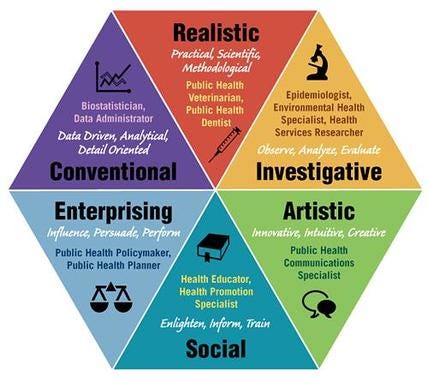
John Holland — Personality Typology Holland said: you are one of six personality types. Find the environment that matches and you'll find satisfaction. His model allowed that you might overlap into one or two adjacent types, but the assumption was still that people fit somewhere on a relatively contained map. The modern career has blown that map apart. The most sought-after professionals today are the ones who live at the intersection, the technologist who can tell a story, the builder who thinks strategically, the creator who understands data. And none of Holland's six types account for the soft skills, emotional intelligence, adaptability, communication, the ability to lead through uncertainty, that have become as valuable as any technical credential. You are not a three-letter code. You are a whole person operating in a world that rewards complexity, and a snapshot taken at twenty-two will never be able to hold all of that.
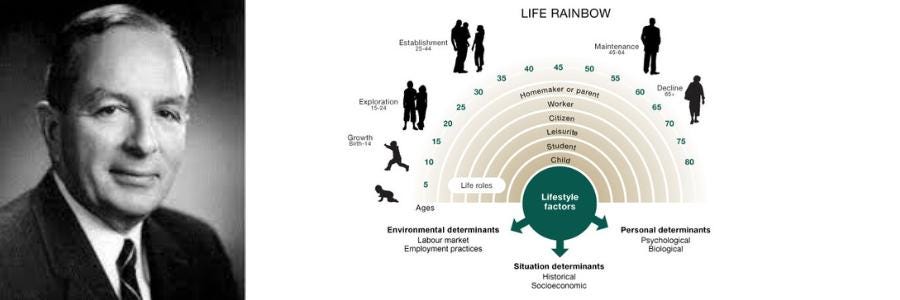
Donald Super — Life-Span Development Theory Super said: career development moves through predictable stages. Growth, exploration, establishment, maintenance, disengagement. In order. He came closest to acknowledging that people are whole human beings with overlapping roles, worker, parent, citizen, caregiver. But even his model assumes the stages move forward on a relatively stable track. The reality is people are getting knocked back to survival mode mid-career, rebuilding after caregiving, and navigating the establishment and exploration stages at the same time. Growth isn’t a stage you pass through once. It’s the constant. The linear progression is the fantasy.
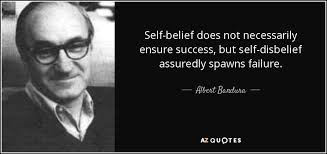
Albert Bandura — Self-Efficacy Theory Bandura said: belief in your ability to succeed determines whether you try. He wasn’t wrong. But he was studying one dimension of a person, confidence, without accounting for everything life does to that confidence over time. Caregiving. Loss. Identity reconstruction. Career disruption. The whole person carries all of that into every career decision they make. Telling someone whose confidence has been dismantled by life to go build their self-efficacy is like telling someone with a broken leg to go for a run. The theory names the barrier. It doesn’t account for what built it or how to dismantle it.
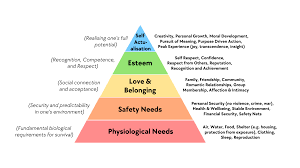
Abraham Maslow — Hierarchy of Needs Maslow said: humans move through layers of need in order, from survival to self-actualization. The hierarchy acknowledged something the other theorists largely ignored: that a person's life circumstances directly shape their capacity for growth. That was important. But the model still assumed a clean upward progression, as if once you've met a level of need you stay there. Anyone who has lost a job, gone through a divorce, or rebuilt after a crisis knows that's not how it works. You don't move neatly upward. You spiral. You lose ground. You rebuild from wherever you actually are. And self-actualization isn't a destination you arrive at. It's something you practice, and return to, for the rest of your life.
What the Theories Share — and What They’re Missing
Read these five frameworks together and the same gap shows up every time. None of them were built for a whole person living a whole life in a world that doesn’t stop evolving. Each one isolates a single dimension. Personality. Stages. Confidence. Needs. Match. They were developed in a time when a career was something you chose once, pursued linearly, and retired from. The assumption underneath all of them is that people are relatively stable, that the world of work is relatively predictable, and that the goal is to find the right fit and stay there. None of that is true anymore. And honestly, for a lot of people, it was never true.
Every one of these frameworks was also built around the assumption that a structured workforce is the destination. The nine to five. The employer. The path that already exists and is waiting for you to find your place in it. None of them leave room for the person who looks at what’s available and decides to build something entirely their own. None of them treat your lived experience as research. None of them suggest that the pivots, the detours, the roles that didn’t fit, and the seasons that broke you might actually be the raw material for something no job posting could have handed you. The most important career some people will ever build is the one they invent. And the frameworks we’ve been handed have no map for that.
What none of these theories account for is that growth is not a stage. It’s the constant. The need to learn, evolve, and rebuild doesn’t end when you land the right job or climb to the next level. It’s the work of a lifetime. And a framework that treats career development as a problem to be solved, rather than a practice to be lived, will always leave people behind. That person deserves a framework built for who they actually are right now, shaped by everything that has happened since they first tried to answer the question of what they wanted to be when they grew up. Not for who they were. Not for who the path assumed they would become. For who they are still striving to become.
What the Self-Led Life Does Differently
Every theory we’ve covered touches on a piece of it. Parsons wanted you to know yourself. Holland mapped your personality. Super acknowledged your roles. Bandura named your confidence. Maslow ordered your needs. Each one reached toward something real. None of them put it together.
No existing framework combines values, interests, and talents as a single integrated system. No existing framework treats that system as something you return to across a lifetime, not a problem you solve once and move on from. And no existing framework was built for the person who is mid-rebuild, whose confidence has taken a hit, whose life looks nothing like the one they planned, and who needs a place to start that doesn’t require them to have it figured out first.
That’s what the Self-Led Life is built for.
It starts with three things every person carries: their values, what matters most to them at the deepest level, their interests, what they enjoy continuously learning about, and their talents, what they are naturally wired to do. When those three are in alignment, something shifts. People stop chasing external validation and start building toward something that actually fits their lives, personally and professionally. The result isn’t just a better career. It’s a deeper satisfaction with the life you’re living, less of the depression that comes from doing work that doesn’t fit, less of the isolation that comes from feeling like you’re the only one who can’t make the standard path work.
Case in Point: The Messy Middle
My proof isn’t just my own story. Many guests who have sat across from me on my podcast, Notes from the Messy Middle, are living examples of this framework in action, most of them without ever thinking about it. The podcast was never just a show. It’s been research. A proof case built one honest conversation at a time, with people who stopped waiting for the right opportunity to appear and started building from what they already had. Season two will dive deeper into this framework and focus on individuals who are living it in real time.
This is also not a framework you complete once and move on from. It’s one you return to. At twenty-two, at thirty-three, at forty-one, at sixty. After the pivot and after the loss. When the industry shifts and when the family does. The goal was never the right job. It’s a life that’s deliberately yours, built and rebuilt as many times as it takes, from the inside out.
The full methodology lives in the book I’m finishing, Living on Purpose. But the idea is simple enough to say plainly: knowing who you are and being able to build from that is the most transformative thing a person can do. Not just for your career. For your life.
The map most of us were handed was drawn for someone else. It’s time to draw your own.
Erin Gregory is the founder of Erin Gregory Creative, a strategic communications and brand consultancy serving mission-driven organizations. She writes The Self-Led Life on Substack and hosts Notes from the Messy Middle, a podcast exploring meaningful work, pivots, and the messy reality of building something that lasts. She lives in Columbus, Ohio with her three daughters.
This reframes career growth in a way that actually matches how life works now. The idea that it’s not something you “figure out once” but something you return to and rebuild over time feels especially true, because most people aren’t off track, they’re just evolving faster than the frameworks they were given .
You go, girl.